How to Write a Bedtime Story Series That Children Love
One story, told across 30 to 40 nights, and more seasons if listeners grow. Every episode connects to the one before and the one after. Here is exactly how we built ours.
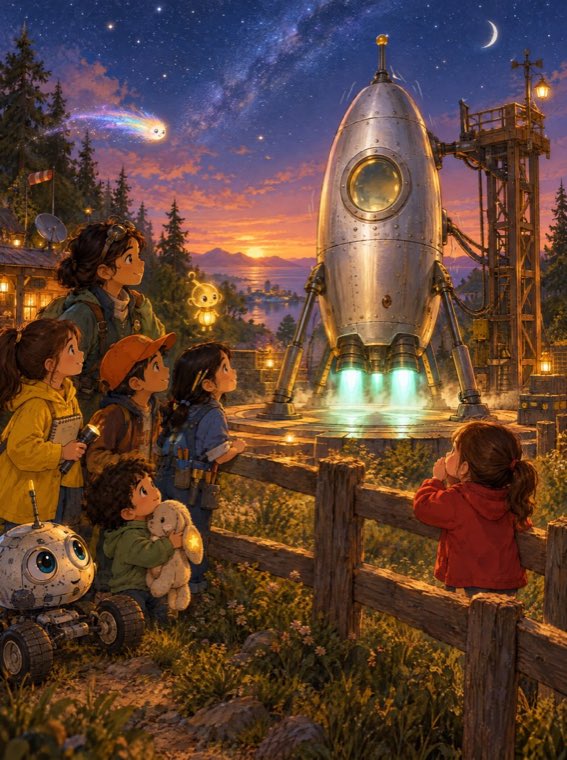
A single bedtime story is a gift. A series is a habit: a child who asks "what happens next?" comes back every night, grows up with the same friends, and starts to feel that the story world is partly theirs.
But a series is not a pile of separate stories with the same characters. It is one long story, told in small pieces. If you can move episode 14 to episode 22 and nobody notices, you have written a collection, not a series.
We wrote a 30-episode series, Rocket Adventures: The Goodnight Lights (listen to it here), then audited every episode and fixed what we found. This guide is the rulebook that came out of that work, with the do's and don'ts we wish we had on day one. Use it for a series of 5 episodes or 40.
The goal of every episode: the child ends it curious about tomorrow and calm enough to sleep tonight, having learned one thing that is true, and having moved one step further along the same story.
Step 1
Start with one story, not 30 stories
Before you plan any episode, write the whole story on one page: a beginning, a middle and an end, as if it were a single short book. Only then cut it into episodes.
Our one-page version: a rocket afraid of heights learns to fly with the help of four children, finds a lost rover, and together they discover why the stars are going out and what only a child's goodnight can do. Every one of the 30 episodes serves that single sentence.
How long? A first season of 30 to 40 episodes gives the story room to breathe. Under 20 and it feels rushed. Over 40 and a child who starts late may never catch up. If listeners keep coming back, you do not stretch the season. You end it well and start the next one (see "Seasons" below).
Step 2
Write the series bible
One page that answers these questions. Everything after is easier.
- The premise in one sentence. Ours: four children become the ground crew of Rocket 5, a small rocket who is afraid of heights, and discover that the stars stay lit because children say goodnight.
- The line the whole series earns. Ours, spoken in episode 29: "The sky is full of friends."
- One age band. We chose 4 to 9. Ages 10 to 14 want the opposite at bedtime (heroes their own age, real stakes, no cuddly rabbit). Serve them with a different series, not by stretching this one.
- A cast where every listener finds a "me". Four children aged 5 to 9, each with a secret worry, a catchphrase and something they teach: Tara (the dark, "But why?"), Kabir (looking silly, "Snack first!"), Sofia (getting it wrong, "Almost perfect"), Jomo (age 5, says night-night to everything). Then a kind adult, a shy rover, a comet who is always late.
- One rule of the world that makes bedtime part of the plot. In Rocket Adventures, saying goodnight keeps the stars lit, and the child blinks three times with Rocket 5 at the end of every episode.
- A mysteries ledger. Write every mystery and the episode where it is planted and where it is solved. Plant few at the start: our first draft put seven characters and five mysteries into episode 1, far too much for a four-year-old. We cut it to two.
- A distinctive name. Search the app stores first. "Rocket Adventures" is generic, and another podcast already has a "Rocket Adventure".
Step 3
Chain every episode to the one before and after
This is the heart of a series. Every episode must be caused by the previous one and must cause the next one. Here is the chain for our first ten episodes. Notice that each ending is literally the start of the next episode:
Seven ways to make episodes feel like one story:
- The hook is the next scene. The question at the end of episode N is answered in the first minute of episode N+1, not ignored.
- The "last time" line sets up the problem. One line, and it is the reason tonight's episode exists.
- Objects travel. The paper star, the flashlight called Beam, the glowing jar, the rabbit with the stitched star: each appears again, changed, when it matters.
- Characters change and keep the change. Rocket 5 starts afraid of heights and ends as the sky's Night Lamp. Kabir learns he can say "I'm scared" without a joke, and he does, later. Nobody resets to zero at the start of an episode.
- Every problem uses what was learned before. Sofia's gentle wiggle fixes a stuck leg in episode 6, a stuck wheel in 16 and a broken door in 27.
- Mysteries have a payoff date. Planted in episode 1, solved in 15 and 29. The child can feel the story moving toward something.
- Spotlight rotates, the plot never does. Each episode belongs to one child, but the plot line runs straight through all of them.
Two tests before you accept any episode. (1) Delete test: remove this episode. Does episode N+1 stop making sense? It should. (2) Swap test: move it ten episodes earlier or later. Does the story break? It should. If the answer to either is "no", the episode is standalone, so rewrite it until the story needs it.
Step 4
Use one episode template, every night
Children love the same shape again and again. It is also what makes a long series safe for sleep: the exciting part is always followed by the same calm part.
Length maths: a bedtime narrator reads 110 to 130 words a minute with pauses. Keep the story body to about 480 words and the whole episode, hush included, stays under 5 minutes. When an episode runs long, cut doubled explanations and jokes that only work if you can see them.
A beat card for every episode (write it before you write the episode):
- Comes from: the last episode's hook
- This episode's problem and which child it belongs to
- The one true fact and who says it
- What changes (a character, an object, what the friends know)
- Goes to: the new question that starts the next episode
Step 5
Hook, then hush
A bedtime hook should ask "what?", "who?" or "how?", never "will they be okay?". The first makes a child curious. The second makes them worried. If there is any danger in the hook, add one reassuring line before it.
Then the hush coda, the same words every night: slower voice, music drops, three blinks, a slow breath, goodnight to each character and to the child. The question stays in the child's head as something to dream about, not something to lie awake over.
Never end an episode on someone being left behind. When our hero seemed to be leaving her friend on the Moon, the episode ended with a friend saying "Wait. I have one more idea. Let me check it while you sleep."
Step 6
What makes children curious
- Callbacks children can spot: Sofia's wiggle, Kabir's jokes, Jomo's night-night.
- Catchphrases they repeat at breakfast: "Snack first!", "Beep... sorry, habit."
- A mystery solved late, so adults want to know the answer too. Our best episodes are the ones where a quiet secret finally comes out.
- A ritual the child can do. Blink three times with Rocket 5.
- Learning inside the story, never as a lecture: one real idea per episode, told by a character at the moment it matters.
Step 7
Make the science hold up
Children and parents notice. If your series promises real learning, the story may not contradict its own facts. In our audit we found these, and you can check your own series against the same list:
- No wind on the Moon, so no clouds of dust drifting up.
- No sound without air: the hum in the cave is felt through the wheels, not heard.
- Stars don't twinkle in space: from the Moon they shine steady.
- A shadow isn't visible in empty space: the Sun is simply hidden.
- Keep the Moon phases consistent, and give sleep needs as a range ("ten to twelve hours").
- An authority character never states fiction as fact. Our engineer, Mina, only says true things. Magic lines go to the rover, the comet or the narrator. A chime marks the true facts, so children learn to tell fact from story.
- When a hero hits a maths problem, change the plan, not the maths. Ours cannot carry her friend home on the fuel she has, so she splashes down in the ocean on a parachute and needs no landing fuel. That is a real engineering lesson.
Have a science teacher read the facts for an hour before launch.
Step 8
Keep continuity like a librarian
- Nobody vanishes. Our comet Pip had no scene for twenty episodes. One passing line fixed it.
- An absent character stays absent. If the engineer leaves the room, a child speaks the Mission Control lines.
- Numbers and names never drift: four landing legs, one cave name, everywhere. Keep a one-page continuity sheet.
- Don't give two characters the same fear. Tara fears the dark, so Kabir's fear is looking silly: "I'm scared, and I can't think of a joke."
- Handle loss softly. The four earlier rockets did not "never learn to say goodnight". They loved the sky so much they chose to stay up there as its first lamps. And a hero who leaves must come back: every morning she comes home, every evening she flies up to say goodnight.
- Soft words only. No grabbed, no exploded, no crashed.
Step 9
Give every episode its own cover
Our first set of 30 covers looked like one picture repeated: the whole crew, standing around the rocket. The cause was simple. The image prompt listed the entire cast every time, so the image generator put everyone in every scene.
The rule: one cover is the most vivid moment of that episode, picked by a person who read the story. Describe only the characters in that moment. Change the camera, the place and the colours from one episode to the next.
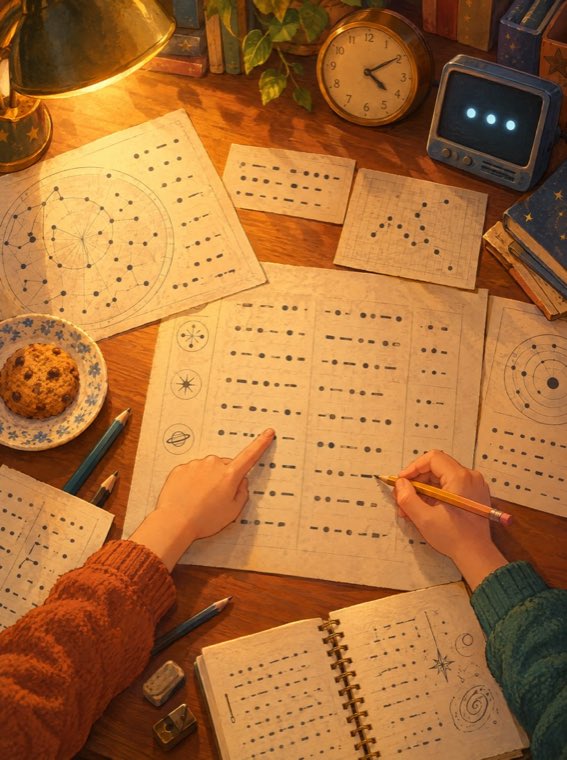
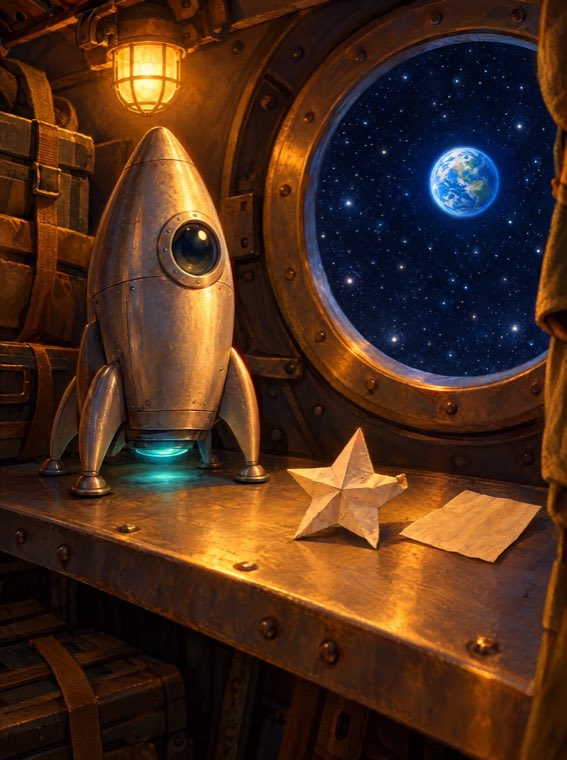
- Mix close-ups of objects (a paper star in a cargo bay), flat-lays (a desk of code), tiny figures in a huge place, silhouettes from behind, and scenes with no children at all.
- Keep a small file with one entry per episode: the scene, the shot, the colours, who is in it. Read all 30 side by side before you generate.
- Tile the finished covers into one contact sheet. Keep the best of any group that looks alike and redo only the repeats.

Do's and don'ts while writing the episodes
- Write the whole story on one page before you write episode 1.
- Open with the same chime and greeting, and close with the same hush, every night.
- Start every episode from the last episode's hook, and end it with a new question.
- Give each child one fear, one strength and one catchphrase, and let them grow.
- Put one real, checkable fact in each episode and say it through a character.
- Bring back objects and phrases from earlier episodes when they matter.
- Keep the story to about 480 words and the whole episode under 5 minutes.
- Let the finale of each season be calm.
- Read every episode aloud, with a timer, before you submit it.
- Don't write a standalone episode. If it has no connection to the one before and the one after, it is not a series episode. Put it in a different collection.
- Don't reset the characters. Nobody should end an episode exactly as they began it.
- Don't introduce a character or a mystery and then drop it.
- Don't end on danger, on someone being left behind, or on "will they be okay?".
- Don't stack five new characters and five mysteries into the first episode.
- Don't explain science in a lecture, or let a character who tells the truth also tell a fib.
- Don't contradict an earlier fact (a number, a name, a rule of the world).
- Don't write all 30 episodes before you have a map, and don't change the map halfway without fixing the episodes before it.
- Don't make the series about one age and then add a 14-year-old's problems.
- Don't use scary words, pop-culture jokes or anything that will feel dated in a year.
- Don't reuse one picture for every cover.
Seasons: what to do if listeners keep coming back
Plan Season 1 as a complete story of 30 to 40 episodes with a real ending. Do not leave it hanging in the hope of a Season 2. If children finish it and ask for more, then you earn a second season.
- Each season answers one big question and raises the next. Season 1 of Rocket Adventures asks: why are the stars going out? and answers it: because the world forgot to say goodnight. The finale ends calmly, with Rocket 5 becoming the sky's Night Lamp.
- Plant the next season's seeds on purpose, in the last third. We left threads that could carry more story: the four first rockets who now shine as stars, the Keeper's garden, what the other lanterns have seen. Treat them as seeds, not promises.
- Keep the world and the rituals. The chime, the greeting, the three blinks and the hush stay identical. A new season changes the adventure, not the bedtime.
- Open the new season with one "last season" line, then a new first problem. A child who starts at Season 2 should still be able to follow it.
- Let the characters grow a year older in feeling, not in age. Keep the age band: the story still belongs to 4 to 9.
- Decide with real signals, not hope: do children finish the episodes, come back the next night, and ask for more? Write Season 2 only when they do.
Step 10
Test it before you publish
- Read every episode aloud with a timer. Under 5 minutes including the hush.
- Run the delete test and the swap test on every episode.
- Grade every hook as curious, mild or worrying, and fix the worrying ones.
- Score the series for idea, characters, hooks, bedtime safety, science, length and values. Ours scored 8 out of 10 before the fixes in this guide.
- Say in one sentence what only your series does. Ours: the only bedtime series that makes children excited to go to sleep tomorrow, 3 minutes a night, ending on a mystery and a calm three-blink goodnight, with science you can check.
- Pilot with a few families before you promise results.
The checklist for every episode
- It starts from the last hook and ends with a new question (delete test and swap test passed)
- Body about 480 words or less, with the open, one-line recap, moral, hook and the same hush
- The hook asks what, who or how, and has a reassuring line if danger is in it
- One real fact, told by the authority character, that matches earlier episodes
- A spotlight child with their own fear or strength, and something that changes
- Nobody disappears, and names and numbers match your notes
- Soft language only
- A cover with its own scene, showing only who is in it
- Read by a person, then released in order
Ready to write your own series?
Open My Sleepy Tale, go to the Creator area, and start your series. Every episode you write is reviewed before it goes live, and your name stays on every one.
Start Creating