How Bedtime Stories Become Learning Tools — A Kindergarten Cognitive Development Framework
This framework was born from a real kindergarten classroom — the Rainbow class at Jean Lumb Public School (JLPS), Toronto, TDSB.
Before I explain the framework, I want to thank the people who made it possible. Ms. Shelagh and Mr. Zak — the educators who gave us their time, their feedback, and their trust. And Jean Lumb Public School, a community that welcomed a bedtime story experiment into their kindergarten program and helped shape it into something meaningful.
What started as bedtime stories for our daughter became a cognitive development tool — thanks to a teacher who said: "Have the kids be the narrators."
That single piece of feedback changed everything. It turned a one-directional bedtime story into a two-way learning experience. The child is no longer just a listener. They are a participant. A narrator. A storyteller.
This article lays out the framework we developed — rooted in real classroom observations, educator feedback, and the Ontario Kindergarten Program. It is designed for three audiences: parents who want to make bedtime count, teachers who want to extend classroom learning into the home, and schools that want a scalable way to connect school and family.
"The most powerful learning happens when a child hears their own experience reflected back to them — in their own voice." — Ms. Shelagh, JLPS
The Three Phases of Early Learning
Early childhood cognitive development does not happen all at once. It happens in phases. Each phase has different capabilities, different milestones, and different ways that bedtime stories can reinforce learning.
We observed these three phases across JK, SK, and Grade 1 students — and designed the "My Voice" feature to meet each child exactly where they are.
Phase 1 — JK: "Word Collectors"
Junior Kindergarten · Age 4-5What the brain is doing
At this age, the brain is a categorization machine. It is naming everything. Sorting everything. Connecting words to sensory experiences. When a JK student touches a hexagonal tile on a sidewalk and hears the word "hexagon," a neural pathway is being built — sound to object, word to meaning.
What kids can do
- Single words and short phrases
- Emotional reactions ("I liked it!" / "That was scary!")
- Naming objects and animals they remember
- Pointing and labeling
"Hexagons!" / "Big turtle!" / "I liked the bus!" / "The spider was yucky!"
Skills being developed
- Vocabulary recall — retrieving the right word from memory
- Phonological awareness — hearing and reproducing sounds
- Confidence — the courage to say a word out loud
- Categorization — sorting the world into groups
Phase 2 — SK: "Sentence Builders"
Senior Kindergarten · Age 5-6What the brain is doing
The SK brain is learning to sequence. It is moving from isolated words to connected thoughts. Cause and effect are emerging. "I did X, and then Y happened." This is the birth of narrative — the ability to organize experience into a timeline.
What kids can do
- Short sentences that describe what happened
- Express feelings with context ("I was scared but then it was fun")
- Describe sequences ("First we walked, then we saw the turtle")
- Begin to explain why ("I liked it because...")
"I found a hexagon on the ground!" / "The turtle was so tiny and it was sitting on a rock" / "I was scared of the spider but then I looked closer and it was cool"
Skills being developed
- Oral fluency — producing connected, coherent speech
- Narrative sequencing — organizing events in order
- Emotional vocabulary — naming complex feelings
- Cause and effect reasoning — understanding "because"
Phase 3 — Grade 1: "Story Makers"
Grade 1 · Age 6-7What the brain is doing
The Grade 1 brain is composing. It is not just remembering what happened — it is interpreting it. Opinions form. Reasoning emerges. "I think turtles are nice because they share." That is not a memory. That is an argument. That is critical thinking in its earliest form.
What kids can do
- Multi-sentence stories with beginning, middle, and end
- Opinions with justification ("I think X because Y")
- Descriptive language ("The turtle was on a sunny rock near the water")
- Making connections ("This is like when we read about...")
"We went to Brick Works and I saw a turtle on a log. It was sharing the sunny rock with another turtle. I think turtles are nice because they share."
Skills being developed
- Story composition — building a narrative with structure
- Critical thinking — forming and defending opinions
- Descriptive language — painting pictures with words
- Ownership of learning — "This is MY story"
How "My Voice" Works in the App
The idea is simple: the AI narrator tells the complete story, but at three key moments per episode, the child's OWN recorded voice plays. The child hears themselves inside the story — as a character, a narrator, a participant.
Here is what it sounds like in practice:
There are three of these moments in every episode. They are carefully placed at emotional high points — the discovery, the surprise, the reflection.
Key details for parents
- It is optional. The story works perfectly without any recordings. The narrator fills in the gaps seamlessly.
- It takes under 1 minute. Three short clips. Tap record, your child says the phrase, tap stop. Done.
- Clips are private. They are stored on your device and in your family's private account. They are never shared, never used for training, never sold.
- You can re-record anytime. As your child grows, their voice changes. You can update the clips — or keep the old ones as a keepsake.
- It works at any age. A JK student might say a single word. An SK student might say a sentence. A Grade 1 student might say a whole paragraph. The feature adapts to wherever your child is.
"When my daughter heard her own voice in the story, she sat straight up in bed and said 'That's ME!' She made us play it three more times." — A Rainbow class parent
What Parents Get
This is not just a bedtime story. It is a bridge between school and home, between learning and sleep, between the classroom experience and the family moment.
Cognitive Reinforcement
Hearing the lesson again at bedtime strengthens memory consolidation during sleep. The brain replays and stores experiences from the day — a bedtime story that mirrors the school day amplifies this process.
Confidence Building
Hearing their own voice in a "real" story makes children feel capable and important. They are not just a student — they are a narrator. That identity shift builds self-efficacy.
School-Home Bridge
Parents hear what happened at school, in their child's own words and voice. No more "What did you do today?" / "Nothing." The story tells you exactly what they learned.
No Screen Stress
Audio only. Eyes closed. No blue light, no visual stimulation. The story is designed to be a calming transition from wakefulness to sleep — not another screen.
Sleep Transition
The familiar school memory becomes a calming bedtime ritual. The child's brain associates the story with safety, familiarity, and rest — making the transition to sleep smoother and faster.
Keepsake Forever
A recording of your child's voice at age 4, 5, or 6 — preserved inside a story about their real life. Years from now, you will play this back and hear the tiny voice that said "Hexagons!" with pure wonder.
What Teachers and Schools Get
For educators, this framework is not extra work. It is a tool that extends the impact of work you are already doing — field trips, classroom activities, curriculum-aligned lessons — into the home, at bedtime, in a format that children love.
Oral Language Evidence
Voice recordings are informal oral assessment data. You hear vocabulary, sentence structure, emotional expression, and narrative ability — all from a 10-second clip recorded at home.
Learning Documentation
Real proof that field trips become lasting memories. When a child narrates their Brick Works visit at bedtime a week later, that is evidence of long-term retention.
Parent Engagement
Families engage with school content at home, daily. Not through a newsletter that gets skimmed — through a bedtime story that gets played on repeat. This is the highest-engagement parent communication channel possible.
Curriculum Alignment
Maps directly to Ontario Kindergarten Program expectations across all four frames: Belonging and Contributing, Self-Regulation and Well-Being, Demonstrating Literacy and Mathematics Behaviours, and Problem Solving and Innovating.
Scalable Template
Any classroom, any school, any field trip can become a bedtime story series. The template is reusable. One school's nature walk becomes another school's museum visit. The framework stays the same.
Report Card Support
Voice clips provide concrete examples for oral communication comments on report cards. Instead of generic observations, you have timestamped evidence of a child's language development.
Want to Create Stories for Your Classroom?
Any teacher or school can build a custom bedtime story series based on their own students' experiences.
Become a CreatorThe Rainbow Kindergarten Case Study
The Rainbow Kindergarten series at Jean Lumb Public School is the first implementation of this framework. Three episodes, each based on a real classroom experience, each mapping to different areas of the Ontario Kindergarten Program.
Shapes at Canoe Landing Park
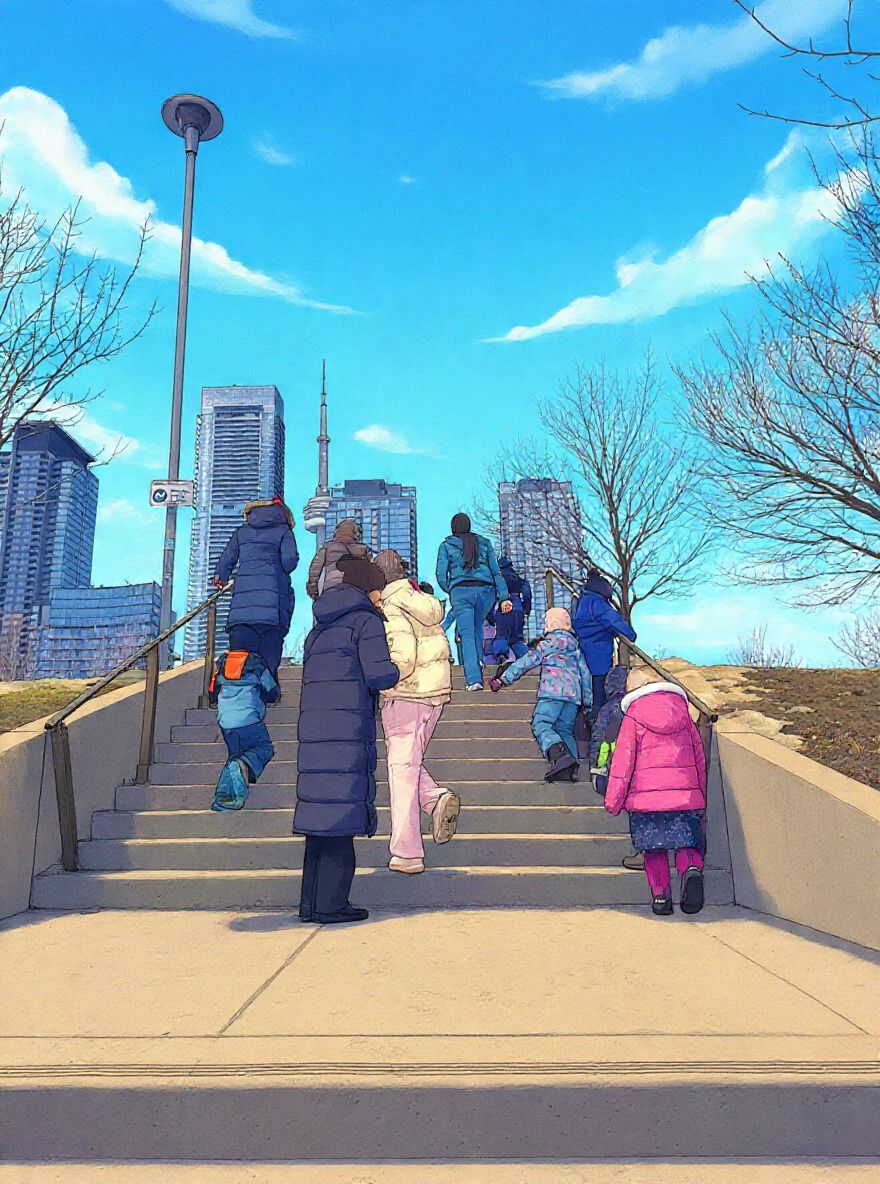
The class walks to Canoe Landing Park and discovers that the shapes they learned in class are hidden everywhere in the real world. Hexagons in the sidewalk. Circles in the playground. Triangles in the climbing structure.
What a Wonderful World
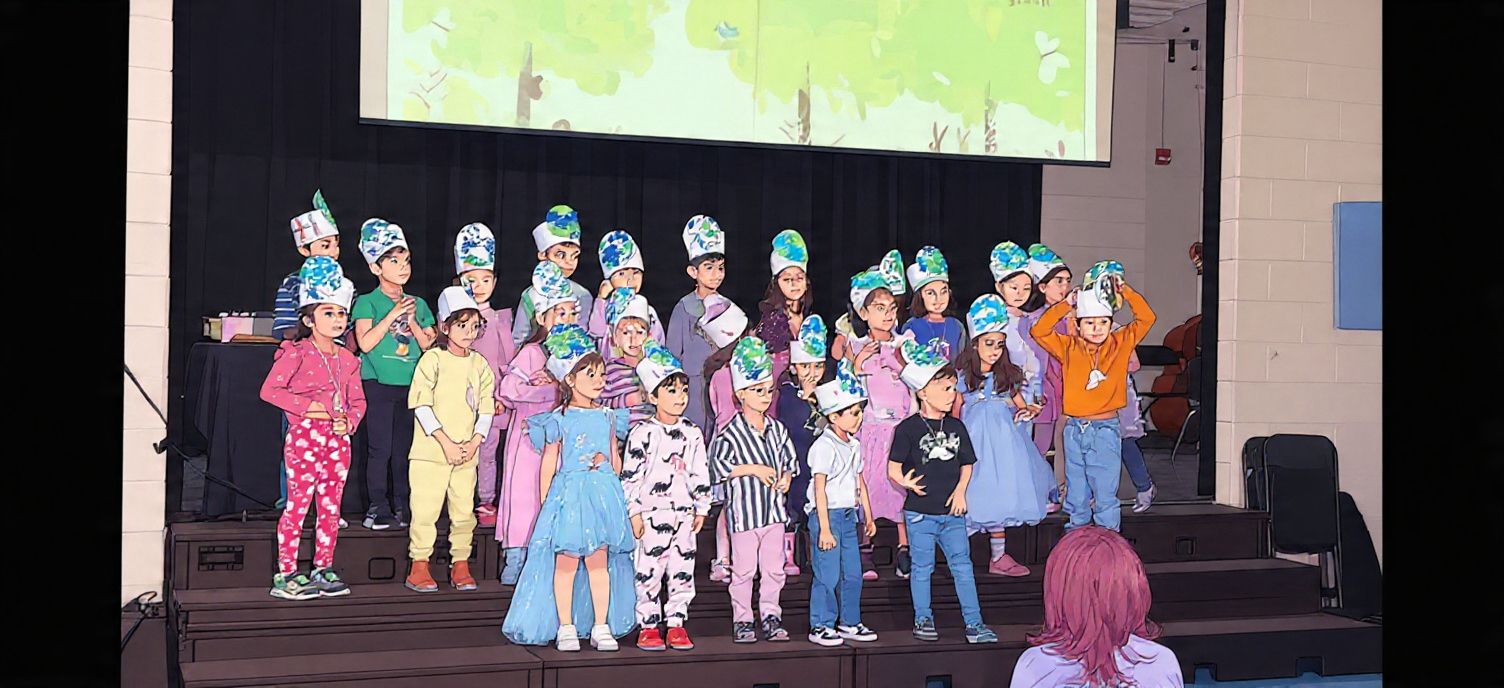
The Rainbow class performs "What a Wonderful World" at a school concert. A story about courage, collaboration, and the magic of singing together — even when you are nervous.
Field Trip to Evergreen Brick Works
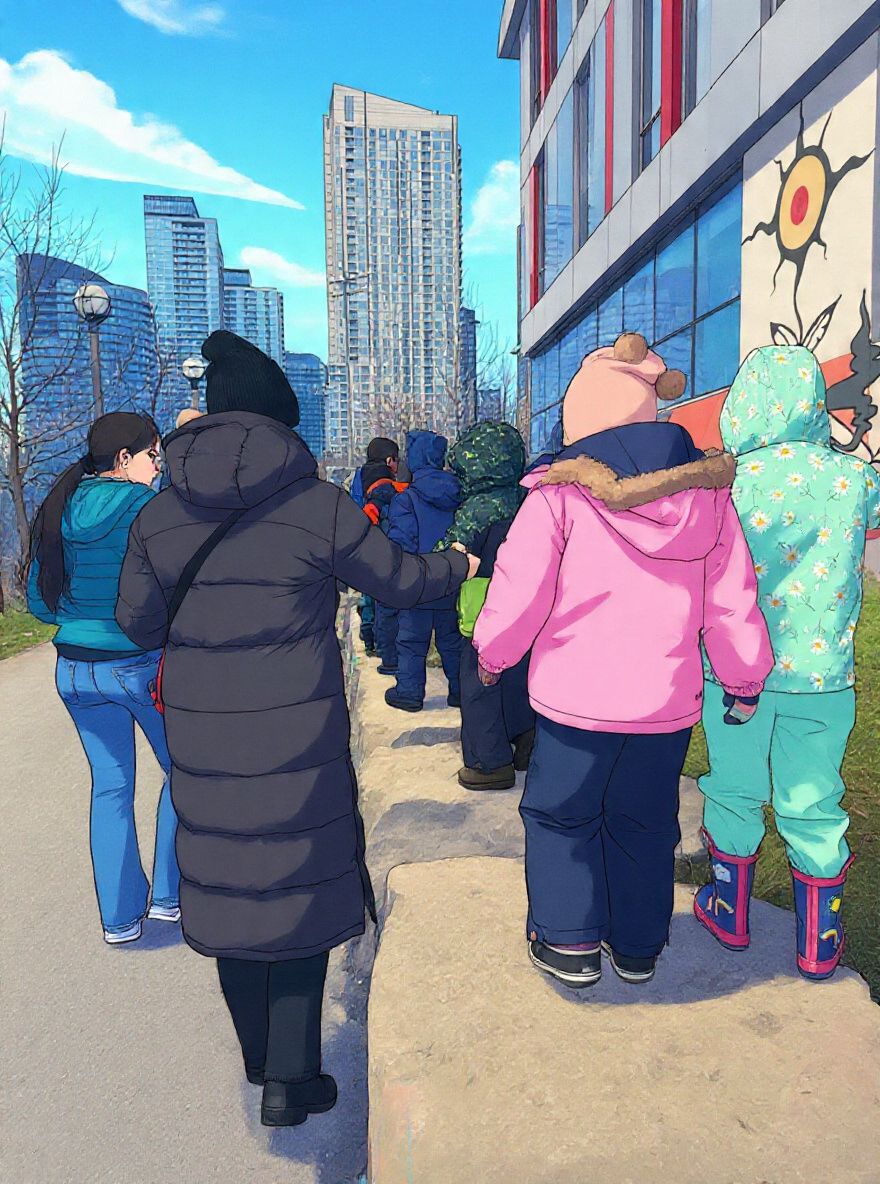
The class visits Evergreen Brick Works and explores the Don Valley. Turtles on logs, spiders in webs, birds in the trees. A lesson about habitats, ecosystems, and sharing space with nature.
How each episode maps to the Ontario Kindergarten Program
The Ontario Kindergarten Program is organized around four frames of learning. Each Rainbow Kindergarten episode touches multiple frames:
- Belonging and Contributing — All three episodes feature the class as a community. Walking together, singing together, exploring together. The child hears themselves as part of a group.
- Self-Regulation and Well-Being — Episode 2 (the concert) directly addresses performance anxiety and emotional regulation. Episode 3 explores cautious curiosity (being scared of a spider, then looking closer).
- Demonstrating Literacy and Mathematics Behaviours — Episode 1 is pure geometry. All three episodes build oral language through the "My Voice" feature. Vocabulary, sentence structure, and narrative ability are reinforced at bedtime.
- Problem Solving and Innovating — Episode 1 asks children to find shapes in unexpected places. Episode 3 asks them to observe animal behaviour and draw conclusions. These are inquiry-based learning moments.
For Other Schools
The Rainbow Kindergarten series is the first. It does not have to be the last.
If you are a parent, teacher, or principal at another school in Toronto — or anywhere — you can create your own series. The framework is the same. The template is reusable. All you need is a real classroom experience and a willingness to turn it into a bedtime story.
Schools we would love to work with
- Waterfront School — the lakeside campus, the ferry rides, the island field trips
- Bishop Strachan School — arts programming, nature campus, inquiry-based learning
- Nelson Mandela Park PS — community garden, neighbourhood walks, Regent Park stories
- Ryerson Community School — progressive education, child-led inquiry, downtown exploration
- Any TDSB school — every kindergarten class has field trips, concerts, and special days worth remembering
- Any TCDSB school — the framework works across all school boards and all curricula
- Schools outside Toronto — Peel, York Region, Durham, Hamilton, Ottawa — this is not a Toronto-only project
The process is straightforward: tell us about your classroom experience, we help you turn it into a 3-episode bedtime story series, and your families get personalized stories with their children's voices inside.
Create a Series for Your School
Your class trip to the ROM. Your school concert. Your nature walk. It can all become a bedtime story.
Read the Creator GuideCredits and Acknowledgments
This framework did not come from a lab or a textbook. It came from a classroom. These are the people who made it possible.
"Your feedback that kids should narrate their own stories changed everything. The 'My Voice' feature — the entire cognitive framework described in this article — exists because of your insight. You saw something we did not see: that the story is not complete until the child's voice is inside it."
"The shape hunt at Canoe Landing. The 'What a Wonderful World' concert. The field trip to Brick Works. Every episode in this series started with a moment you created in the classroom. You gave twenty children experiences worth remembering — and we turned those memories into bedtime stories."
"A school that welcomed an experimental bedtime story project, gave us feedback, and trusted us with their community. The Rainbow class of 2025-2026 is the heart of this project, and JLPS is its home."
"Twenty children who taught us that the best bedtime stories do not come from imagination — they come from real life. Your hexagons, your turtles, your songs, and your laughter are the foundation of everything we built."
Frequently Asked Questions
Try the Rainbow Kindergarten Series Tonight
Three episodes. Real classroom adventures. Your child's voice inside the story. Free.
Listen Free on My Sleepy Tale